How hotels can stop being invisible to AI
Almost no hotel is ready for the way travelers now choose where to stay: by asking an AI. The good news is that fixing it rarely costs money, it costs doing a handful of things right.
In the previous article we saw why hotels stay invisible to AI. Here is the other half: what to do about it, and almost all of it is within reach of any hotel.
A recent study, RaceMyDesk's TADI index, analyzed more than seven thousand hotels and found that almost none is ready for AI to understand and recommend it. The good news is that it has a fix, and it rarely costs money: it costs doing it well. And the first thing is a change of mindset. For years the goal was to rank on Google; that still counts, but it is no longer enough. There is now a second goal that matters just as much: getting AI to understand you and name you when someone asks for a recommendation. And to name you, it first has to be able to read you. Everything starts there.
Let AI read you
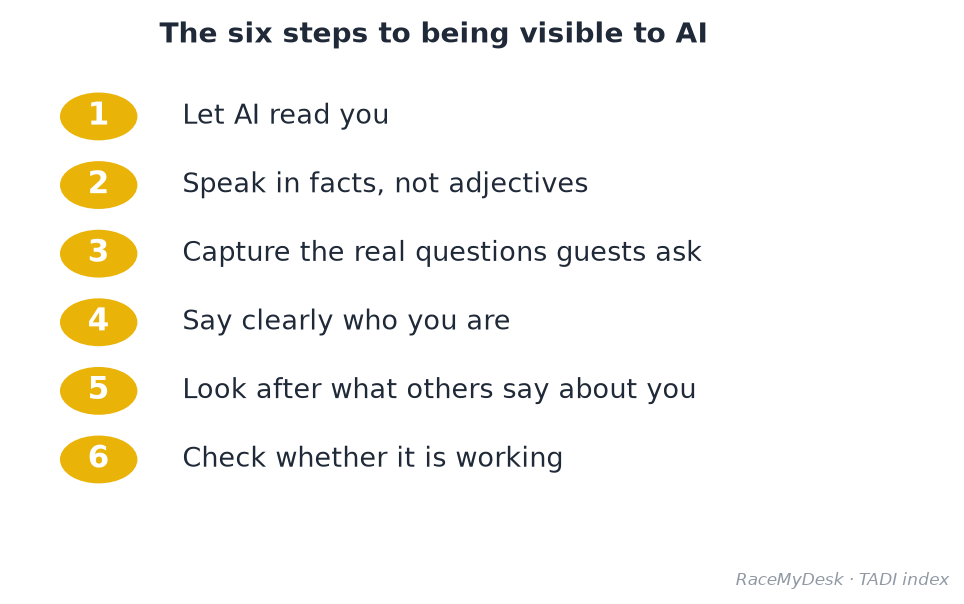
The first step, and often the simplest, is making sure AI can get in and read your website. As we said, some pages unknowingly block that access or hide their content behind visual effects. Checking that your site does not shut the door on AI, and that the important text is really on the page, in plain sight, is usually a quick fix with an immediate payoff.
Speak in facts, not adjectives
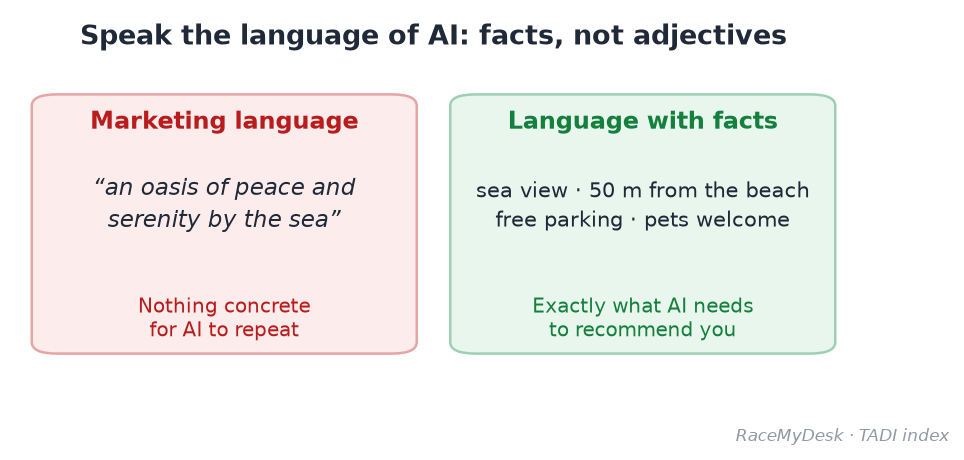
The second step is the most decisive, and also the easiest to grasp: speak in facts instead of adjectives. It is the change that makes the biggest difference. A website can describe a room as “an oasis of peace and serenity by the sea,” or it can say “sea-view room, 50 metres from the beach, free parking, pets welcome.” Both describe the same hotel. The first sounds lovely and is useless to an AI, because there is no concrete fact to repeat. The second is full of data, and that data is exactly what AI needs to recommend you when someone is looking for, precisely, a hotel near the beach that takes dogs.
Capture the real questions your guests ask
The third step follows the same line. It is worth gathering on your website the real questions a guest asks before booking, each with a clear answer beside it. Is there parking? What time is check-in and check-out? Is it near the beach or the centre? Is it good for kids? Is there a heated pool? Having those questions and answers laid out not only helps the guest browsing your site, it is exactly the kind of information AI feeds on to build its answers.
Say clearly who you are
The fourth step is to say clearly who you are. It sounds obvious, but many websites do not do it: they do not make clear what kind of hotel they are, where exactly they are, and what kind of traveler they are meant for. If that information is not explicit, AI infers it as best it can, and sometimes gets it wrong: it confuses a city hotel with a coastal one, or describes it as ideal for families when it is really aimed at couples. Making clear who you are keeps others, or the machine itself, from describing you badly.
Look after what others say about you
The fifth step acknowledges an uncomfortable but important reality. Right now, when a traveler asks, AI relies mostly on the big booking platforms, the review sites and the travel media. So while you get your own website in order, you also have to look after what those other sources say about you: keep your information on the platforms correct and complete, respond to reviews, and get the travel media and guides to talk about your hotel. It is work on two fronts: your own house, and the reputation others build around you.
Check whether it is working
The sixth and final step is to check whether all of this is working, and to begin you need no complicated tool. Just do what a guest would do: ask an AI now and then about hotels in your area or of your type, and see whether you come up and how it describes you. And, above all, ask new guests how they found you. When answers start coming in along the lines of “I found you by asking an AI,” you will know the work is paying off.
Start by knowing where you stand today
It all starts, really, by knowing where you stand today. Just as a hotel reviews its online reputation or its accounts from time to time, it is worth running a kind of exam to see what AI can read and understand on your website right now. That initial snapshot is what lets you know where to begin and, later, measure the improvement. That is exactly what the TADI index measures.
The hotels that win in the AI era will not be the ones with the prettiest website, but the ones whose website AI can truly read.
Key takeaways
- The goal is no longer only to rank on Google, but to be readable and quotable by AI.
- Speak in concrete facts instead of adjectives: it is the change that makes the biggest difference.
- Capture the real questions your guests ask, and make clear who you are and who you are for.
- Look after what the platforms, review sites and media say about you, and check now and then whether AI names you.
Frequently asked questions
Why does my hotel show up on Google but not in ChatGPT?
How long does it take AI to notice changes to my website?
See how visible your hotel is to AI
The TADI index checks whether ChatGPT, Gemini and Perplexity can discover, understand and cite your hotel, and shows you what to fix first.
Explore AI Visibility