What hotels get wrong when travelers ask AI where to stay
Most hotels never come up when a traveler asks AI where to stay. Not for lack of technology, but because their website speaks the language of people, not the language of the AI that now decides who gets recommended.
Ask an AI for a hotel recommendation and it comes back with two or three names, no more. If yours is not one of them, then as far as that traveler is concerned, it does not exist. And most hotels never make the list, for a reason few of them would guess.
More and more travelers are planning their trips a different way. Rather than opening Google and weighing up ten tabs, they put the question straight to an AI and go with the two or three names it gives back.
An industry failing a test it does not know it is taking
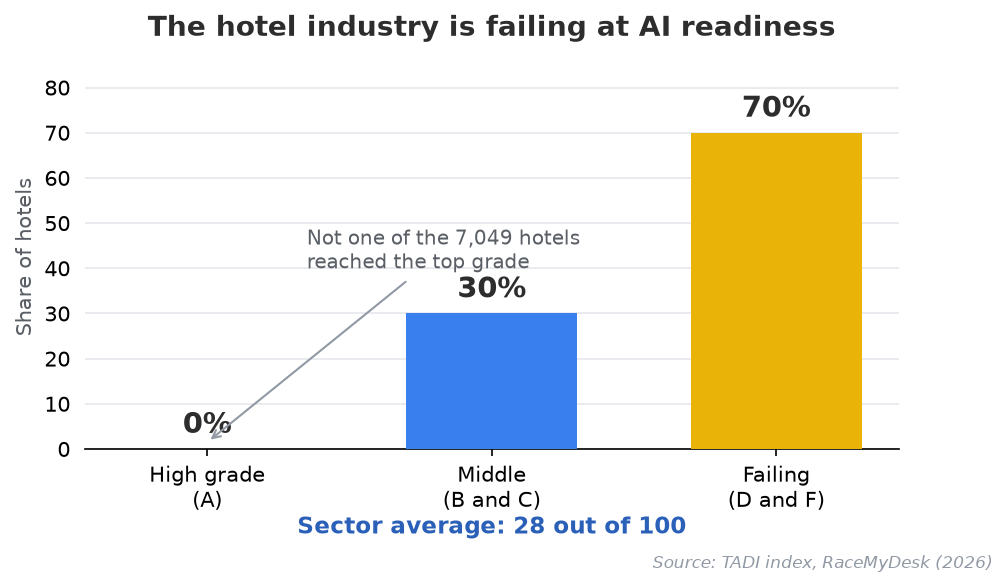
Check where an AI got its recommendation and you will rarely find the hotel's own website; you will find the big booking platforms, the review sites and the travel magazines. To measure the gap, RaceMyDesk, the consultancy founded by Bartomeu Gili Prohens, ran 7,049 hotels across more than 30 countries through an index it calls TADI, which scores whether a hotel's website is ready for AI to understand and recommend it. The industry average came in at 28 out of 100, a clear fail: seven in ten hotels scored in the bottom grades, and not one of the seven thousand and more reached the top.
Beautiful websites AI cannot read
The most striking finding concerns luxury hotels: five-star properties tend to score below three- and four-star ones. Their sites are so rich in animation and visual effect that, underneath, they are built in a way AI simply cannot read. They load fast and they are secure, so this is not a technology problem. The problem is what the pages say and how they say it. Most are written to inspire, packed with lines like “an unforgettable experience” or “the perfect getaway,” when what AI needs are concrete facts it can repeat: how far the beach is, whether pets are welcome, whether there is parking, who the place is for. On top of that, some sites block AI outright when it tries to read them, without the hotel ever knowing.
If AI cannot read you, it quotes someone else
When AI cannot read a hotel's website, it does not come back empty-handed; it goes looking elsewhere. In the study's own test, asked about hotels in Palma, the AI drew on five sources to build its answer, and not one was a hotel's website. Every source was a third party: booking platforms, review sites and travel media. The good news is that almost all of this is fixable, and rarely by spending more. How to do it is the subject of the next article.
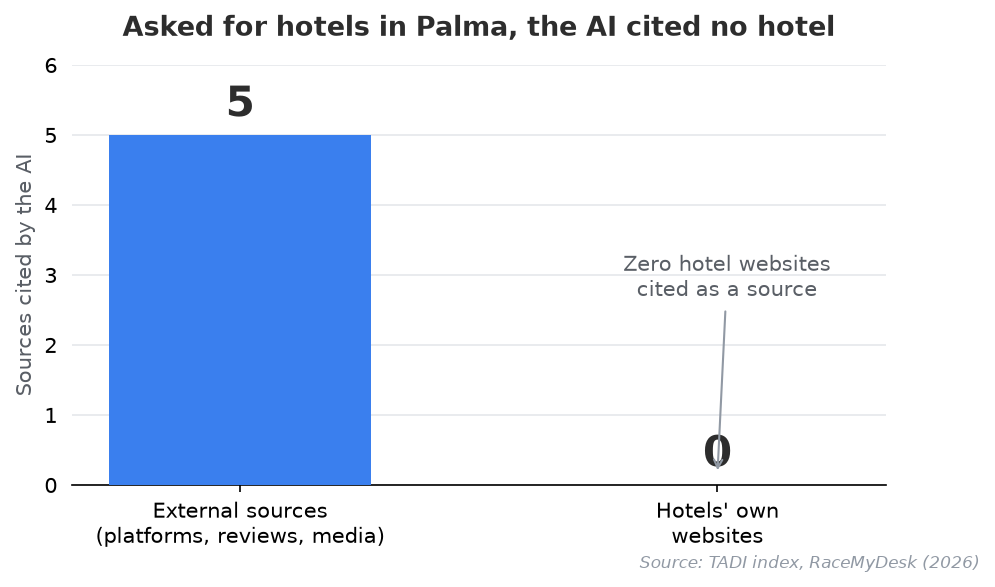
Today, the story AI tells about your hotel is not written by you. It is written by the booking platforms, the review sites and the travel media.
Key takeaways
- The industry's average AI-readiness score is 28 out of 100: seven in ten hotels fall into the bottom grades, and none reach the top.
- Five-star hotels often score worse than three- and four-star ones, because visually rich sites can be unreadable to AI.
- AI wants concrete facts (distance to the beach, parking, pets, who the hotel is for), not marketing adjectives.
- When AI cannot read your site, it builds its answer from booking platforms, review sites and travel media instead.
Frequently asked questions
Is this a technical problem with our website?
How do I know whether AI can see my hotel?
See how visible your hotel is to AI
The TADI index checks whether ChatGPT, Gemini and Perplexity can discover, understand and cite your hotel, and shows you what to fix first.
Explore AI Visibility